Maritime chokepoints
The Strait of Hormuz is not the only international waterway that could be leveraged for geopolitical benefit.

Iran’s effective control over the Strait of Hormuz, and attempt to monetize it by charging a toll of a few million dollars — paid in Chinese yuan — is a geopolitical reckoning that may echo beyond this conflict, whenever it ends.[4/8 update: With the cease-fire agreed, Iran is now charging ships $1/barrel of oil, to be paid in cryptocurrency.]
The UN Convention on the Law of the Sea lays out international rules governing transit in international waters including Article 24, Duties of the coastal State, stating that territories bordering a “territorial sea” “shall not hamper the innocent passage of foreign ships.” In non-territorial water foreign ships (including of military-nature) are guaranteed free passage.
In other words, it is expressly illegal to impose a duty on ships passing through an international waterway like the Strait of Hormuz.
US Secretary of State Marco Rubio has noted as such, labeling Iran’s action as both unacceptable and illegal. That being said, the White House doesn’t really have much of a leg to stand on here.
Indeed, Trump vowed to eliminate a “whole civilization” and commit genocide against the Iranian people if Tehran did not agree to open the Strait.
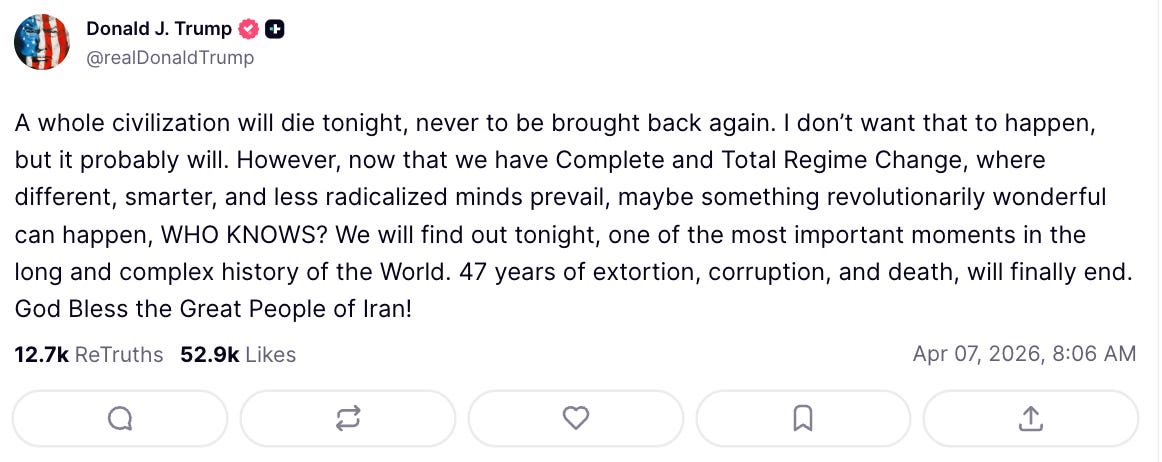
Trump’s 11th hour agreement to a two week cease-fire with Iran (and Israel, through the incursion into Lebanon continues apace) opening the Strait is obviously a good thing, but it doesn’t change the underlying situation.
Trump didn’t follow through with his threat that “a whole civilization will die tonight”, but it is wholly unacceptable for any leader to make such a claim. In a normal world, the Cabinet (by invoking the 25th amendment) and Congress (by passing a war powers resolution followed by impeachment) would take action immediately to remove him from office.
Of course, most of the GOP is feckless and the Veep is currently in Hungary campaigning on behalf of Viktor Orban, Putin’s very important ally in Europe. (What happened to the idea we don’t want foreign interference in elections?)
Facing what it views as an existential crisis, Tehran, like Beijing last year with its wielding of rare earths or Washington in the past using its power over the global financial system, recognized its geopolitical leverage and exploited it for gain.
Importantly, the Strait of Hormuz is not the only open, critical marine waterway at risk of becoming a geopolitical pawn.
Fossil fuel suppliers are clustered near the Strait of Hormuz while their customers are concentrated around the Strait of Malacca in Southeast Asia.
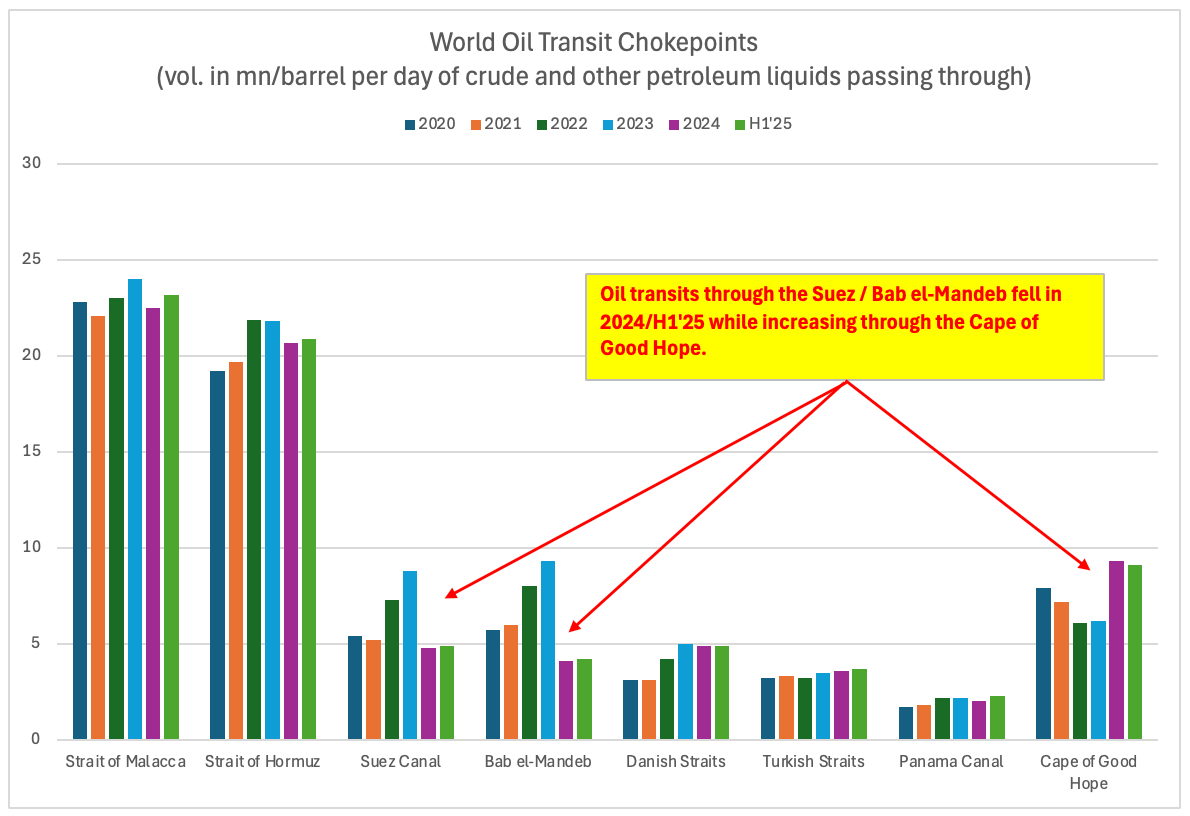
And in a world where Iran takes advantage of its geo-strategic location near a critical waterway, could Trump and Netanyahu have just unleashed a new era of trade where key transit paths are controlled by geographically adjacent parties?
Below, we discuss six key global trade chokepoints.
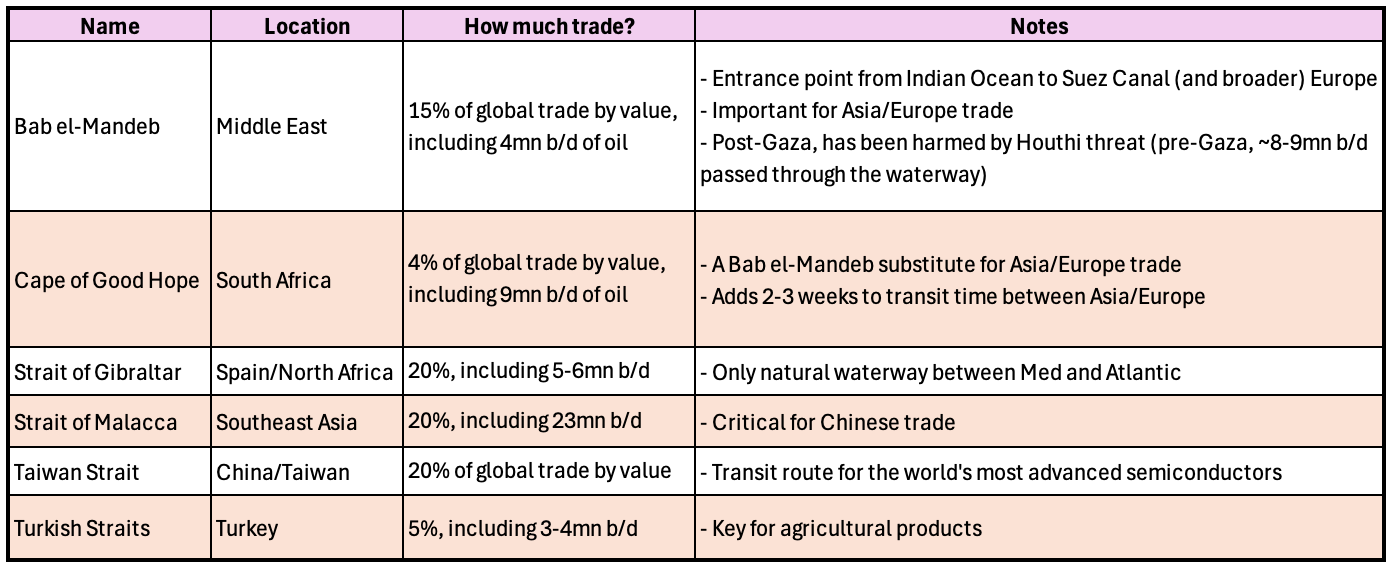
Sources: Trade by value & Oil trade
I would much appreciate it if you could hit the like ❤️ button!
It helps more people discover Nuance Matters and is a cost-free way to let me know you appreciate the work!
Bab el-Mandeb Strait
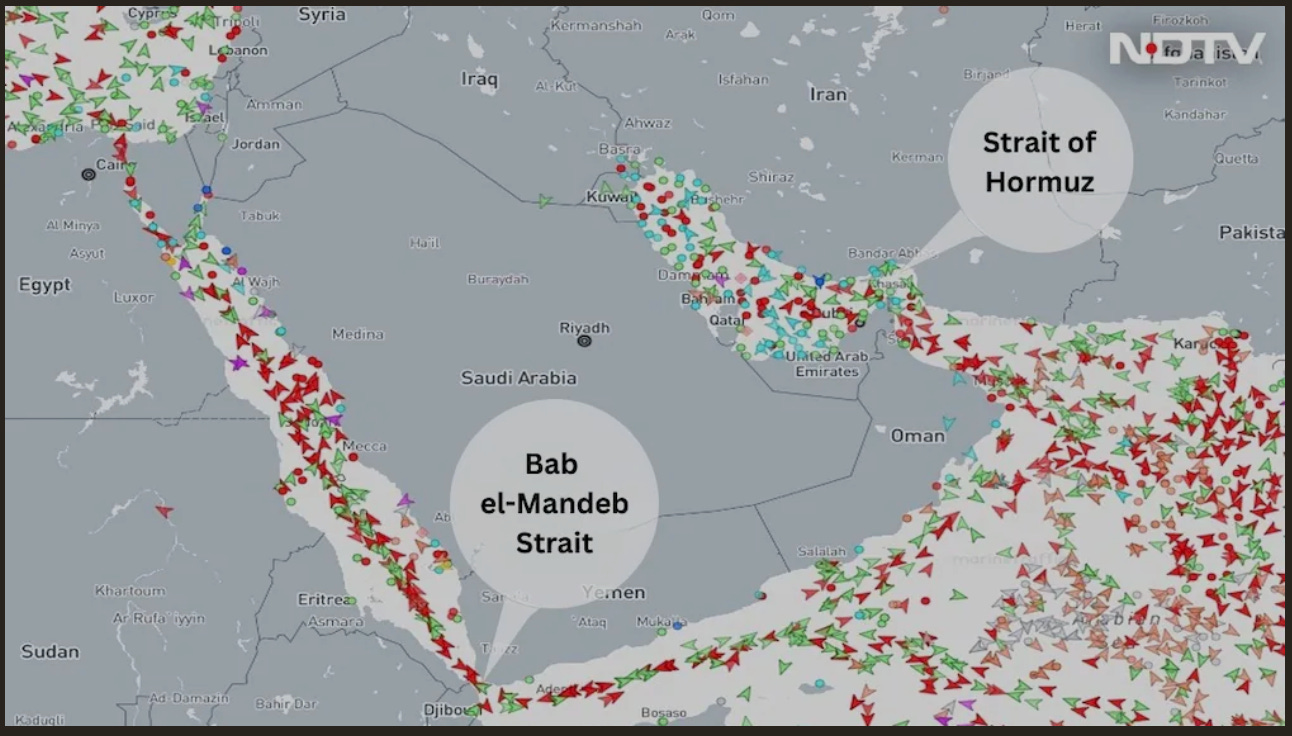
Where is it? Middle East/North Africa, between Yemen and Djibouti/Eritrea
What transits through? ~15% of global trade by value, including 4mn barrels of oil/day
Who is this a major chokepoint for? While the neighboring Strait of Hormuz is important for the fossil fuel trade, the Bab el-Mandeb (Arabic for “Gate of Tears”) plays a more critical role in commercial as well as inter-Middle East trade.
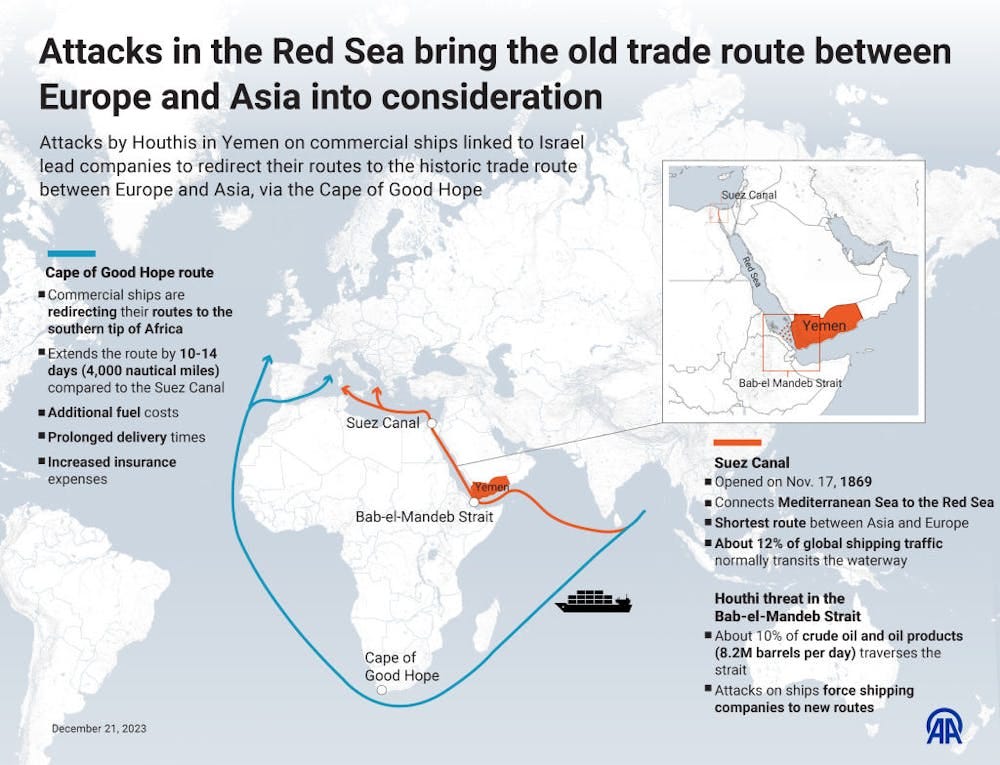
Its place as the connection point between the Red Sea (and with it, the Suez Canal, the Mediterranean, and Europe) to the Gulf of Aden (which flows to the wider Indian Ocean) makes the Bab el-Mandeb especially important for trade between Asia and Europe.
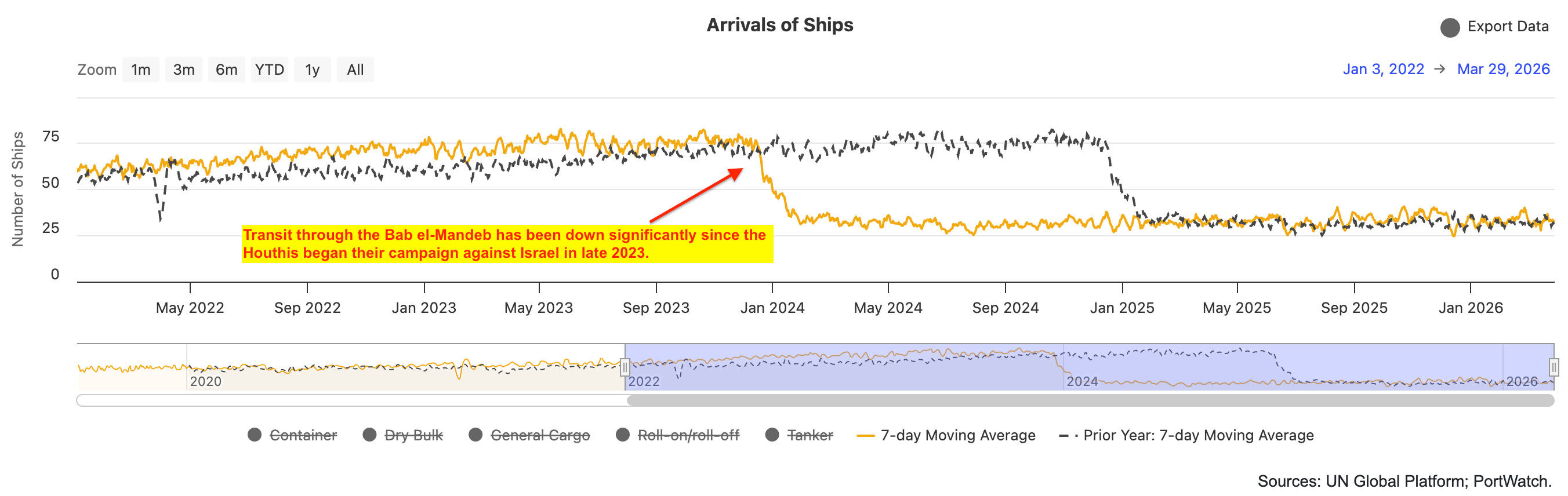
The amount of crude oil passing through the Bab el-Mandeb has increased since the start of the Iran war, but is still well below typical levels transiting through the Strait of Hormuz (~20mn b/d).
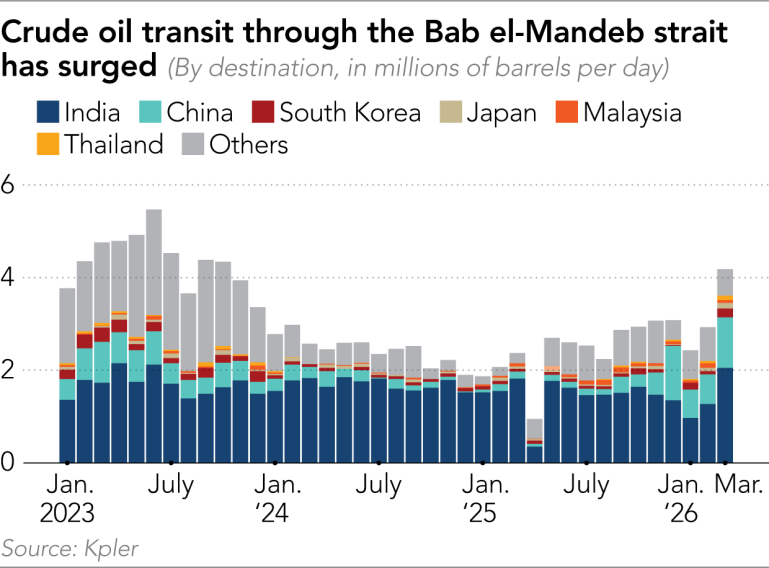
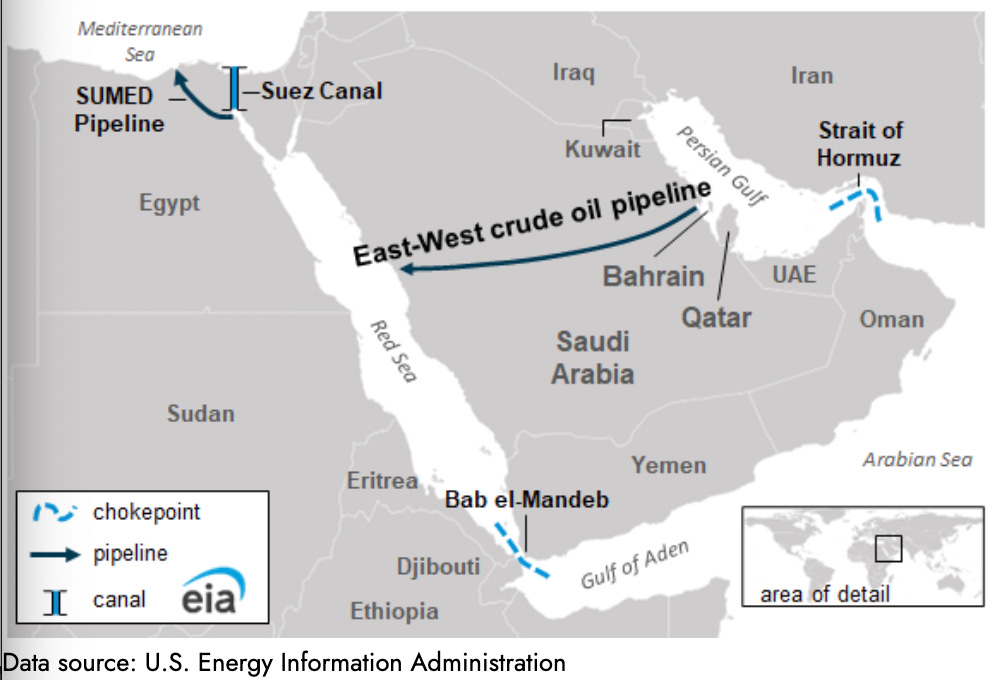
Since the Iran war began, Saudi Arabia has been sending more crude through its East-West Pipeline in order to ship it through the Red Sea via the Bab el-Mandeb.
Map of Saudi Arabia’s East-West pipeline built to bypass Strait of Hormuz.
The risk: Following Israel’s invasion of Gaza in late 2023, the Houthis in Yemen demonstrated just how vulnerable the Bab el-Mandeb can be to hostile actors. In the the years since, the number of ships transiting through the waterway has fallen because of this threat. And in recent days, Iranian officials had threatened to use the Houthis to effectively pull a Strait of Hormuz and close the Bab el-Mandeb to shipping.
Cape of Good Hope