
What to know about the current state of US/Saudi relations
Trump, both politically and economically, has engaged more closely with the Saudi Royal Family.

You may recall that in May, Trump’s first scheduled foreign trip of his second term was to the Gulf1 where one of his first stops was Saudi Arabia. During this trip, Trump announced the Saudis had committed to invest $600bn in the United States and invited the Saudi crown prince Mohammed bin Salman (MBS) to visit Washington.
MBS is the son of the Saudi leader, King Salman. At 89 years old, the King is up there in age so MBS is the Kingdom’s de facto ruler (a title he has held for a decade). Back in 2018, the Saudi journalist Jamal Khashoggi, was brutally murdered at the Saudi consulate in Istanbul. The CIA concluded that MBS sanctioned Khashoggi’s murder, an assertion the Kingdom denies.
Earlier this month, MBS made the trek to DC where he was feted with a 21-gun salute, a military fly-over and a state dinner attended by a who’s who of people in business and tech, including Elon Musk.
Trump and MBS meet with the media in the Oval Office.
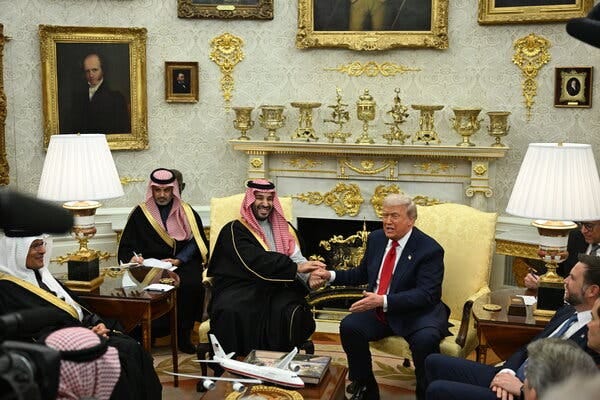
During the press avail this time, Trump rebuked a journalist who asked MBS about Khashoggi’s murder.
“A lot of people didn’t like that gentleman that you’re talking about,” Mr. Trump said, referring to Mr. Khashoggi….“Whether you like him, or didn’t like him, things happen. But [MBS] knew nothing about it, and we can leave it at that. You don’t have to embarrass our guest by asking a question like that.”
This exchange and the dinner drew the headlines, but stepping back from this: what did each side get out of the most recent meeting, and what is the current state of US/Saudi relations?
I’d be grateful if you could hit the like button ❤️ !
It helps more people discover these ideas and lets me know what’s connecting with readers.
US/Saudi defense relationship
Mutual defense arrangement
It has long been a goal of the Saudis to obtain a US security guarantee and after the Trump administration extended one to Qatar earlier this year, it was widely expected a similar arrangement with the Saudis was forthcoming.
The Trump administration brokered a defense arrangement with Qatar in September to reassure the government after Israel’s surprise attack earlier in the month. Per the terms of the US/Qatar agreement, any attack on the Gulf state is considered a threat to the ‘peace and security’ of the US. As a result, some view this deal as analogous to the mutual defense commitment the US provides is closest allies.
So, it came as little surprise when Trump designated Saudi Arabia as a major non-NATO US ally. Saudi Arabia joined a list of 20 other territories2 who bare this designation. Reaching this level strengthens defense cooperation but does not come with an automatic security guarantee. But while the deal may claim to be mutual, in practice it is more of a unilateral pact for the US to support Saudi Arabia.
Note: It’s important to consider that this US/Saudi arrangement was made by Trump without formal Congressional approval, and might end up becoming the latest example of the impermanence of foreign policy via executive order. Should a new administration more hostile to the Saudis (or the Qataris for that matter) enter the White House in 2029, the new president could easily reverse the executive order. This is why treaties and the like are typically negotiated by the executive branch and then approved by the legislative branch.F-35 sale
During Trump’s May visit to the Gulf, the administration announced the Saudis would purchase $142bn worth of US arms. But the Saudis wanted more.
This time around, Trump approved a plan to sell nearly 50 F-35 fighter jets to Saudi Arabia for ~$5bn. The F-35s, recently deployed by the US military to act as cover during the bombing run in Iran in June, are some of the most advanced military technology in the world. The US doesn’t just sell F-35s to anyone who asks for them. Previous orders have been formalized with long-time American allies like Europe, Canada, Australia, Japan and South Korea.
The sale of F-35s raises a couple of issues, one of which is the impact on the US’s long-time regional ally, Israel, currently the only country in the region with F-35s. And as part of a decades old US/Israel deal, codified into law by Congress in 2008, Israel must be allowed to maintain a “Qualitative Military Edge” over its regional rivals to preserve a level of deterrence. By approving this sale, it would seem that Trump has elevated the US’s military relationship with the Saudis to a level commiserate with Israel.3
Additionally, in recent years the Saudis have developed closer security ties with China. As such, US military intelligence has flagged that should the Saudis obtain these fighters, it was possible China might have access to this technology. In a similar vein it should be noted that Turkey, a NATO ally, has previously tried to purchase F-35s but been denied because of Turkey’s close links to the Russian military.
Similar to the defense agreement above, while Trump has given the OK, Congress also has to approve the sale.
The Abraham Accords
Relatedly, Trump (and Biden before him) has tried to convince the Saudis to join the Abraham Accords — to recognize Israel and normalize Saudi-Israeli relations. During Biden’s presidency, there seemed to be some momentum in this direction but this came to a screeching halt following Hamas’s attack and Israel’s response. Right now, public sentiment across the Gulf is strongly against any sort of backing for Israel.
Accordingly, the Kingdom maintains that Palestinian statehood must be recognized before any Israeli normalization can occur. MBS reiterated this point during his meeting with Trump. “We want to be part of the Abraham Accords, but we want also to be sure that we secure a clear path of a two-state solution.”
Commercial agreements
Civilian nuclear program
Trump and MBS agreed to cooperate on a Saudi civil nuclear energy program.
Since MBS became the de facto ruler of the Kingdom ten years ago, the Saudis have sought to move beyond fossil fuels and diversify the economy. One way the House of Saud has tried to do so is via nuclear power, with the help of a nuclear ally.
On the positive side of the ledger, this would help reduce oil production / consumption, something that is badly needed to curb climate change. At recent climate negotiations, the Saudis have been one of the chief obstructionists, but broadening its options for energy sources could help (at least, domestically).
The concern? That this kicks off a regional power struggle to obtain nuclear weapons. First Iran, the Kingdom’s chief rival in the region, grows worried that this nuclear program could produce a weapon, and decides to pursue its nuclear ambitions. This pushes MBS and co. to decide they need nuclear weapons as a deterrent against Iranian aggression, and precipitates a downward spiral of proliferation.
AI and critical minerals
Like much of the industrialized world, one of the ways the the Kingdom is trying to diversify its economy is by latching on to the artificial intelligence boom. This year, Riyadh has invested into AI data centers, working on projects with Big Tech firms like OpenAI, Oracle and Google. The Saudis’ ambition is to scale up enough to provide 6% of AI global computing capacity (from less than 1% now) and become the third largest global player (behind only the US and China). The Saudis are also investing in their own sovereign AI program, Humain.
But to have a cutting edge AI program, you need the most advanced technology, which right now come in the form of Nvidia chips. During MBS’s visit, the Trump administration approved the sale of up to 35,000 Nvidia chips to the Saudis (and the Emiratis).
Companies also need access to critical minerals, a sector currently dominated at both the mining and processing phase by China. MP Materials, a US firm which the federal government took a direct stake earlier this year, announced it would work with a Saudi state-owned company to construct a minerals processing factory in the Gulf.
For the US, forging an alliance on nuclear power and a critical minerals supply chain are key steps in the process of reducing emissions and breaking China’s monopolization of critical minerals and rare earths. These relationships though will take time to bare fruit.
Does the Kingdom actually have any money to spend?
A military alliance, advanced military technology, nuclear support, AI chips, this all seems like a good deal for Saudi Arabia. But in the era of Trump, where everything is a deal and ‘America First’ is the name of the game, what does the US get?
Back in May, the Saudis committed to spend $600bn on investments in the US4. Then during the latest round of talks, Trump suggested the Saudis might increase their investment to a cool $1 trillion. MBS played along, saying the economic agreements signed dealing with military tech, rare earths etc. “will create a lot of investment opportunities.”
But this belies a critical point: low oil prices have put a damper on Saudi investment plans and caused a real retrenchment. Sure, the Kingdom still pumps oil worth a reported $500mn/day(!). But right now, the Saudi Public Investment Fund (PIF), the Kingdom’s trillion dollar sovereign wealth fund, is low on cash, a situation not helped by the fact that some of the Kingdom’s most ambitious projects have turned into billion dollar boondoggles.
The vast majority of the PIF’s investments so far this decade have been in the domestic market. It’s international investments have stayed relatively flat and its cash balance has started to dwindle.
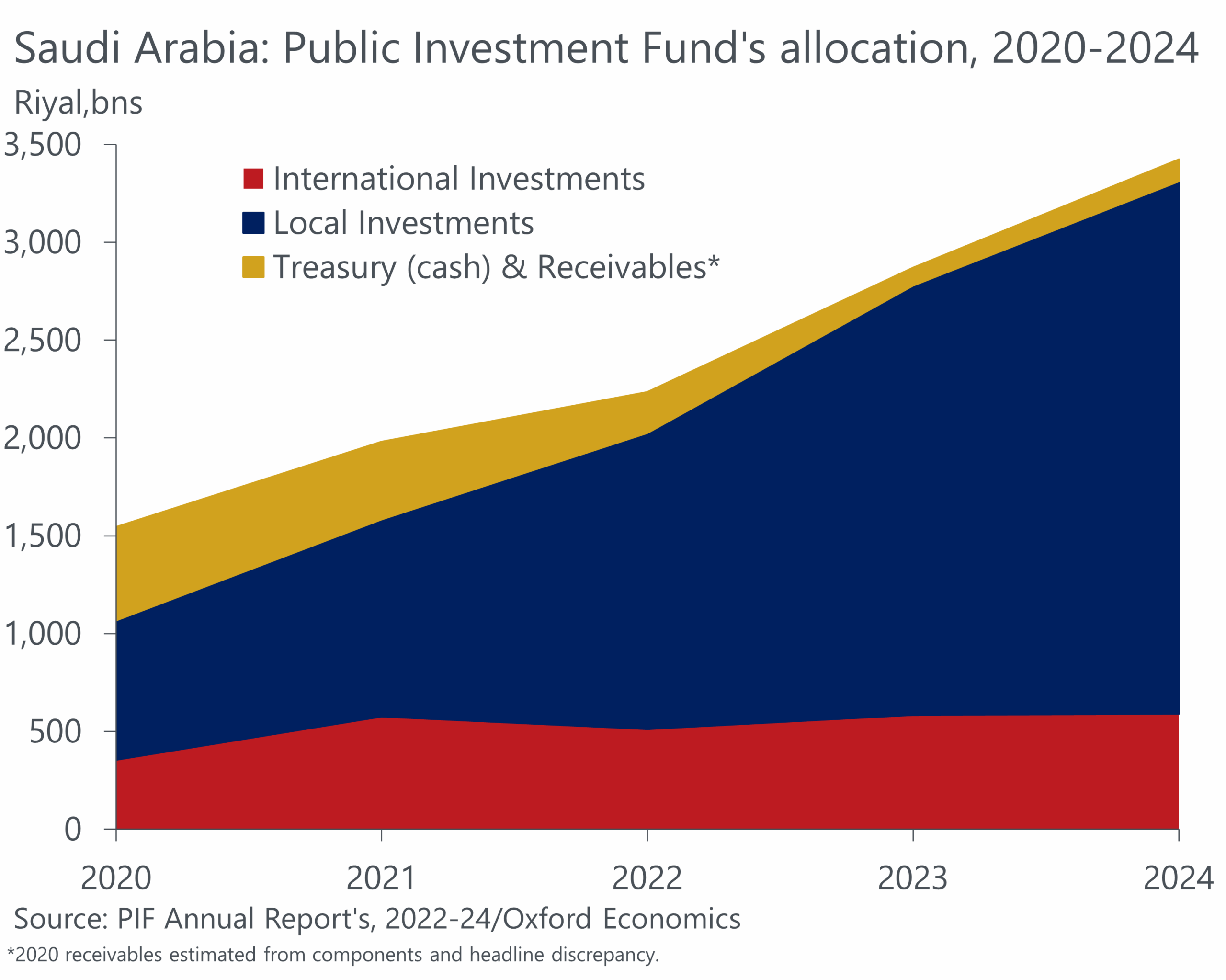
In fact, the Kingdom has started issuing more debt to finance its ambitions pushing the Saudis to turn into a net importer of capital. Right now, both the US and Saudi Arabia appear more interested in attracting investment rather than shipping it abroad.
Indeed, the PIF divested at least part of its share in over a dozen US-listed companies this year as it reorients its focus on domestic investment.
But this hasn’t stopped the Saudi Royal Family from cultivating close ties to the Trump family.
After Trump left office in 2021, the Saudis maintained close business ties with the Trump family.
Last September The New York Times reported the PIF provided $2bn to Affinity Partners, the private equity firm established by Jared Kushner, Trump’s son-in-law, in 2021.
Just before MBS’s visit stateside, the Trump Organization announced a joint-venture with DarGlobal, a Saudi real estate developer, to build a luxury resort in the Maldives. This particular project is allowing outside investors to get in by using cryptocurrencies to purchase fractional shares, which presents an opportunity for a great deal of financial tomfoolery that could invite a host of illicit actors while providing anonymity in the process.
This just the duo’s latest link-up, the group has announced a handful of other developments in Saudi Arabia since Trump was re-elected last year. DarGlobal reportedly paid Trump ~$20mn last year, and is expected to make a similar payment this year.
If you enjoyed this edition of Nuance Matters, consider letting me know by buying me a cup of coffee!
Cheers!
The actual first overseas trip was to the Vatican for the Pope’s funeral.
19 countries + Taiwan
Though Israel’s actions in Gaza the past two years certainly justifies quite a bit of soul-searching on the part of the US when it comes to support for the Israeli military.
Even if some of these investments were already in the works.